Friday, March 30, 2012

2.3.1a Miniature Train

Almost Spring Break 2012, and in class we have been constructing a miniature train in our CAD Inventor software programs.
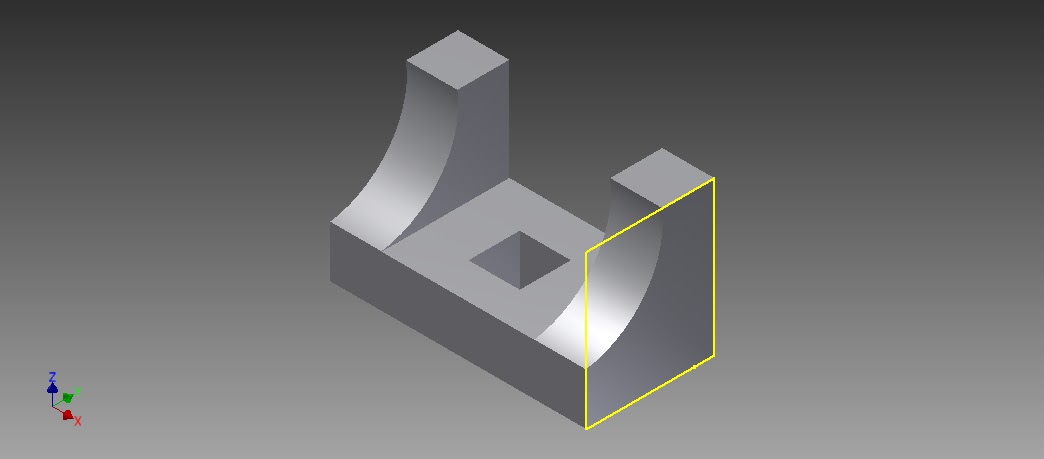
Here are my sketches for the train body, stack, hitch magnet, hitch peg, wheel, axle peg, linkage arm, linkage peg, and cow catcher assemblies of the train, I still need to assemble them all together and create the straight track piece, but that can wait until after Break.


Wednesday, March 28, 2012

Egg Drop Challenge

My partner, Sean Lee, and I, competed against the class last week in the Second Annual Egg Drop Challenge. We used an awesome elevator design, which involved a plank that leaned over the edge, taped it down and added counterbalances to the other side, so it would not fall, hurting someone. It also involved a long piece of string, a small cardboard box, more rocks, a ton of dominoes, a lot of duct tape, and socks. We used the box as a container for the egg, and inside we had a sock as a cushion on the bottom of the egg, and we used the other sock for a top cushion. We used some of the dominoes inside the box with the egg in order to create more weight in the box. On the other side, we used duct tape to make a counterbalance with rocks, slightly heavier, probably 10-15 grams more, than the box with the egg. We used the string to attach the two parts (the box with the egg/counterbalance) and then we let it go on the plank, and it slowly, safely, and surely lowered down to the ground without the egg breaking. We earned a lot of achievements, listed below.
Achievements:
  • Brainstorming:
    • Create a sketch of one possible solution.
    • Create a sketch of another possible solution.
    • Create a sketch of a third possible solution.
    • Use a decision matrix


Size
Weight
Safety
Speed (slow)
Accuracy
Total
Parachute
1
1
3
3
2
9
Elevator
3
3
1
1
1
9
Wings and Parachute
2
2
2
2
3
11

  • Material Preparation:
    • Generate a list of materials required for build day
    • Document a plan to ensure materials are brought in on block day
      • Sean Lee will bring in the egg, cardboard box, foam/bubble wrap, and masking tape. I will bring in the wood plank, rocks/counterbalances, and the long string
  • Size:
    • Your materials fit inside a printer paper box
  • Weight:
    • Your materials weigh less than 500 grams
  • Drop Accuracy:
    •  You hit the butcher paper!
    • You hit inside the third ring!
    • You hit inside the second ring!
    • You hit inside the first ring!
    • You hit the Bullseye!
  • Drop Time:
    • Your solution takes more than 2 seconds to hit the target!
    • Your solution takes more than 3 seconds to hit the target!
    • Your solution takes more than 4 seconds to hit the target!
    • Your solution takes more than 5 seconds to hit the target!
  • Egg Resilience:
    • Your egg didn't break in any way! (awarded three times)
    • Your egg didn't break in any way! (awarded three times)
    • Your egg didn't break in any way! (awarded three times)
  • Calculations:
    • Used arithmetic to calculate the amount of weight needed for the counterbalance
    • Used geometry in the size and measurements in the box
    • Used algebra to find out how long it would take for the box to reach the ground
  • Other:
    • Helped set up the Bullseys
In Total: 24 Achievements

Here is our product in action:

Wednesday, March 14, 2012

Khan Academy

I watched the Khan Academy video about the events and summarizing of World War II and the Vietnam War.
http://www.khanacademy.org/humanities---other/history/v/us-history-overview-3---wwii-to-vietnam
That is the link to the 15 minute long video

Sustain:

I really enjoyed this video because of its great historical content. It accurately and quickly summarizes major happenings in between World War II and the Vietnam War. If we were learning this in our regular history class, it might have taken one 50 minute period to cover the topics. On Khan Academy, the topics were covered in less than 15 minutes and I understood the subject to the fullest.

Change:

The only thing I would change about this video is that I would put in a little bit more words and space the information out a little bit more, because all of the major event were cramped into a little space.

I believe that the "flipping the classroom" paradigm is great and it should be applied in schools nowadays because, as I said, I learned a lot about the events between the wars in a small amount of time.

Friday, March 9, 2012

2.1.6 CAD Sketches

We are currently working on creating objects by replicating them from a piece of paper into Inventor.
We were asked to make six sketches.


Wednesday, February 29, 2012

Balsa Wood Airplanes (Gliders)

For the past couple of weeks, my partner, Sean Lee, and I built a Balsa Wood Airplane. It was a long and tedious project, but it was fun, especially when we were able to fly them in the gym. We had a few challenges to achieve when we flew the airplanes, like the farthest flown, the longest flight, and the highest height reached. Our Balsa Wood Airplane achieved the longest flight, competing with Sammy, Israel, and Chase. On the other hand, we had to make a ton of adjustments with the eggshell white tape, which basically threw us out of the Best Decorated Flyer contest. We had to make a ton of adjustment, including fixing a broken wing and changing the tilt of the plane. Overall, it was an awesome project, I enjoyed the construction and viewing our projects in action.
My partner and I used the Project Lead the Way Design Process when we identified the constraints and criteria, finding out what we could do, based on our materials. We also tested and evaluated how the plane flew, as shown by the pictures below. Lastly, we refined the glider to make an excellent design that flew well, also, as shown below.

Throwing our Glider

Our repaired and adapted glider

Me and Sean with our finished Glider

Our repaired and adapted glider


Game Changer-Money Ball

1) What was the “Moneyball” approach that Billy Beane and Peter Brandt applied to the Oakland Athletics 2002 season? Was it an “art” or a “science”? What single statistic did they boil their value consideration down to? (In class research/discussion)

The Moneyball approach that was applied to the Oakland Athletics in their 2002 season was to attempt to create a great, winning team on a very low budget. I consider this a science because the game is an art, but the approach included calculations, formulas, and statistics. Billy Beane and Peter Brandt boiled down their value consideration to On Base Percentage, which to them was the only thing that mattered.

2) What is the equation used to calculate OBP? (In class research/discussion)
The equation used to calculate On Base Percentage is OBP=(H+BB+HPB)/(AB+BB+HBP+SF), where H is hits, BB is base on balls (Walks), HPB is times hit by a pitch, AB is at bats, and SF is sacrifice flies. I believe the equation could be simplified to OBP=(H)/(AB+SF).

3) What is design? (In class research/discussion)
A design has an assortment of definitions, like a plan or blueprint, or it could be more of a mental design, which is like a vision, or a mental guideline.

4) Describe 3 situations where movie characters (intentionally or not) applied a step from the PLTW 12 Step Design Process. Explain both the (a) situation as well as (b) how the step is relevant:

1-In the beginning of the film, when everyone is discussing their attempt to recover from the players they lost, Billy Beane is focusing on discovering the main problem.

2-Peter Brandt created equations to discover the players' averages and based from that, he let people go and hired others to advance progress in the problem of replacing the main players.

3-Throughout the whole movie Billy Beane is revising his team in order to have his ideal team playing, like in Project Lead The Way, when you revise until completion. He ran a working team, where he could change around the team, like editing it, until he hit the sweet spot and got a 20 game winning streak.

5) What is “Leadership”? List the three aspects of leadership that we come up with in class. (In class research/discussion)

1 -Direction

2 -Alignment

3 -Commitment

6) Describe 3 circumstances from the story where a character exercised effective leadership:

1-Billy Beane did what was the best for the team when he traded Jason Giambi

2-Although in the background, Peter Brandt was the one who really led the team with his idea of Moneyball

3-Billy Beane stays focused on the objective of winning and On Base Percentage throughout the whole film

7) According to the movie, what was the A’s record at the start of their winning streak? 68 : 51

8) What does this ratio simplify to (roughly)? 1.33 : 1

9) How long was the A’s record setting winning streak? 20 games won.

10) Given the A’s win/loss ratio at the start of the streak (listed two questions above), what are the odds of winning 20 games in a row? Run the numbers. (In class research/discussion)

The odd of winning 20 games in a row is .57 to the 20th power which is simplified to 0.000013. When further calculations were made, our class discovered that to reach the ideal truth of 1, there would have to be 474 seasons of baseball played. With each season there are 162 games, there would have to be 76,788 games played.

11) Based on your calculation, do you think the A’s got lucky or was there something to the Moneyball approach?

I believe that the approach to Moneyball had to do with the 20 game winning streak because the team was based upon who got on base, and obviously, if you can't get on base, you don't score runs, and if you don't score runs, you don't win. The Moneyball approach was not based on the player's skills all together, but rather solely on the On Base Percentage of the player.

12) Did Billy Beane strictly apply the “science” of Moneyball to his management approach? Was there an “art” to his efforts as well? Describe a circumstance where he broke from the Moneyball approach to make a positive change for the team.

Billy Beane applied the Moneyball approach to his management most of the time, and he didn't really make his efforts an art, but made them remain a science. At one time he broke the Moneyball approach when Beane decided to trade Jason Giambi, a Moneyball pick, but it was for the better of the team because Giambi didn't take it seriously.

Bonus Question (look into this if you’ve finished ahead of the class):
Money Ball was originally a book. What author wrote the book? What other books has this author written? Is there a theme to his writing?

The author of Moneyball was Michael Lewis, who wrote other books, such as The New Thing, The Blind Side, Liar's Poker, and The Big Short. His writing theme seems to be based around the weaker person triumphing, like a modern day David vs. Goliath.

It's "Oscar Season", will Moneyball win the Oscar for any of the categories it's up for?

Since "Oscar Season" just passed, I saw that Moneyball did not win any awards, unfortunately, although it was a great movie.